Brass and terminals from distribution boards: how to separate and sell them
Brass and terminals from distribution boards: how to separate and sell them
When you sell brass for scrap, you get less per kilogram than for bare copper, but considerably more than for most copper cables. In the WIP price list (retrieved on 16 Nov 2026), new brass (Mosadz nová) is €4.20 per kg and tap brass (Mosadz kohútiková) €4.00 per kg, while Cu MIX is €9.60 per kg. Terminals, bridges and pins from distribution boards are therefore worth putting in a separate container, not among the copper or the cables.
Where you find brass in electrical installations
Brass is an alloy of copper and zinc. When dismantling old distribution boards and wiring, you will come across it mainly here:
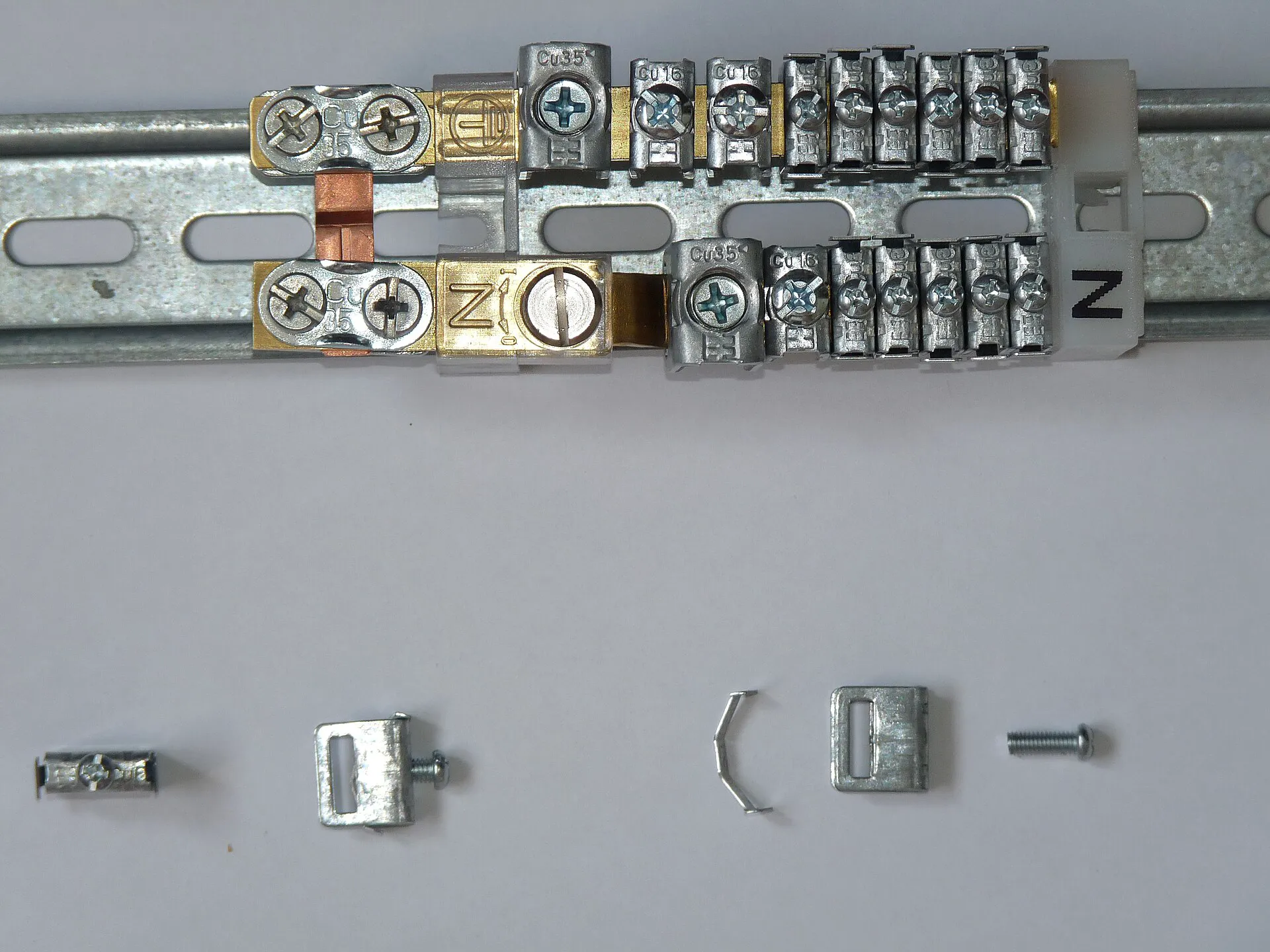
- terminals and terminal blocks in distribution boards, for example neutral and protective earth terminal blocks and older rail-mounted terminals,
- bridges of equipotential bonding terminal blocks,
- metal cable glands, usually nickel-plated,
- plug pins and socket contacts,
- brass screws, nuts and washers from terminals.
For example, the terminal and terminal block catalogue of SEZ Dolný Kubín lists the material of its terminal blocks as Ms (brass) or electroplated brass, and for the EVP equipotential terminal block a brass bridge with steel clamps. Busbars in distribution boards, on the other hand, are usually copper, often tinned, and belong with copper, not with brass.
How to tell brass from copper and steel
| Material | Surface colour | Colour when cut or scratched | Magnet |
|---|---|---|---|
| Copper | reddish brown, copper | copper | does not attract |
| Tinned copper | silvery, dull grey | copper | does not attract |
| Brass | yellow, golden | yellow | does not attract |
| Nickel-plated brass | shiny silver | yellow | does not attract |
| Steel (including galvanised) | grey, silvery | grey | attracts |
In practice two tests are enough. A magnet separates steel, because neither brass nor copper is ferromagnetic. A file or knife shows the colour of the metal under the coating: yellow means brass, copper-coloured means copper. For nickel-plated glands and terminals, use both tests.
Depending on its composition, brass has a density of 8.4 to 8.73 g/cm³, so you cannot tell it from copper (8.96 g/cm³) by weight in your hand. Colour is what counts.
How much copper is in brass
Brass is not "weaker copper" but a separate raw material. The common free-machining brass CuZn39Pb3 (CW614N, Ms58), from which screws, terminals and small parts are turned, contains 57 to 59% copper, 2.5 to 3.5% lead and the rest zinc according to its material data sheet. Wrought brass CuZn37 (Ms63) has about 63% copper.
If you convert the brass price to the contained copper, you get:
price per kg of copper in brass = price per kg of brass ÷ copper share

New brass, Ms58:  €4.20 ÷ 0.58 = approx. €7.24 per kg of copper
New brass, Ms63:  €4.20 ÷ 0.63 = approx. €6.67 per kg of copper
Cu MIX:                              €9.60 per kg of copper
This is only an indicative comparison. With brass, the buyer does not pay only for the copper; zinc also has value, but brass has to be processed separately from copper. That is why brass is a separate item in the price list and why there is no point mixing it with copper.
Buying brass: prices in the WIP price list
Brass items in the WIP price list retrieved on 16 Nov 2026:
| Item in the price list | Price per kg |
|---|---|
| New brass (Mosadz nová) | €4.20 |
| Tap brass (Mosadz kohútiková) | €4.00 |
For comparison, the same price list has Cu MIX (burnt and tinned copper in pieces) at €9.60 per kg and copper cables at €0.50 to €4.00 per kg depending on metal content. Prices change with metal prices on the exchange; current prices are in the WIP price list.
The price list does not state which of the two brass items terminals and glands from distribution boards belong to, or how brass with steel screws is assessed. If you have a larger quantity, check the classification in advance with the WIP cable buying point (káblovňa) in Bratislava on +421 911 829 999. The final classification is made by the buyer when inspecting the material.
Want to compare brass with copper and cables? All non-ferrous metal items are in one place.
Calculation: what mixing brass and copper costs (illustrative)
When replacing an old distribution board, you are left with 6 kg of brass terminals and bridges and 4 kg of tinned copper busbars.
Separately:
  New brass     6 kg × €4.20 = €25.20
  Cu MIX        4 kg × €9.60 = €38.40
  total                        €63.60

Everything in one bag, classified as brass:
  New brass    10 kg × €4.20 = €42.00

Difference:                    €21.60
The calculation is illustrative; prices are from the WIP price list as of 16 Nov 2026. How the buyer classifies a mixed batch depends on its composition, or the buyer may have to re-sort it. The opposite mistake, brass among copper, is also costly: for the buyer, brass in copper is an impurity that can lower the classification of the whole copper batch.
How to prepare terminals from distribution boards for sale
- Keep a separate container for brass during dismantling. Next to it, a container for bare copper and one for cables.
- Remove the steel parts. Separate steel screws, washers, springs and DIN rails; a magnet finds them quickly.
- Remove the plastic terminal housings where this is easy. Polyamide plastic is not paid for and reduces the purity of the batch.
- Cut off remaining conductors. Pieces of copper wire in the terminals are an impurity for brass and are worth more in the copper container anyway.
- Check nickel-plated pieces with a file. Yellow in the cut goes with brass, grey and magnetic with steel.
- Put plug pins with brass if you have many of them. Whole plugs with cords belong with cables, as described in the article Buying thin cables.
The general procedure for sorting scrap cables on site is in the article Sorting cables on a construction site.
Refurbishing several distribution boards at once? For larger volumes of material, a container delivery or collection can be arranged.
Common mistakes
- Brass in the copper container. For the buyer it is an impurity, not extra weight.
- Copper busbars in the brass container. You sell copper at the price of brass.
- Steel screws in the brass. A magnet reveals them in a few seconds.
- Nickel-plated steel among the brass. It looks the same as nickel-plated brass; a magnet shows the difference.
- Whole terminals with plastic and conductor remnants. The more foreign material, the worse the classification.
Frequently asked questions
What is the buying price of brass?
According to the WIP price list as of 16 Nov 2026, new brass is €4.20 per kg and tap brass €4.00 per kg. Current prices are in the price list.
How can I tell brass from copper?
Brass is yellow to golden, copper reddish brown. With a surface coating (tin, nickel), a file or a scratch with a knife shows the colour. A magnet attracts neither of them.
Is brass magnetic?
No, brass is not ferromagnetic. If a magnet attracts a piece, it is steel or a part with a steel component, such as a screw.
Are terminals from distribution boards made of brass?
Many are. Terminal blocks and bridges are often made of brass, frequently electroplated, while busbars are usually copper. Screws can be brass or steel, so check them with a magnet.
How much copper is in brass?
Common brasses contain roughly 57 to 70% copper, some types even more. Free-machining brass CuZn39Pb3 for screws and terminals has 57 to 59% copper and up to 3.5% lead, the rest is zinc.
Conclusion
Buying brass is a worthwhile addition to copper and cable scrap for an electrician. In the WIP price list as of 16 Nov 2026, new brass is €4.20 per kg, less than bare copper at €9.60 but more than most copper cables. When dismantling distribution boards, it therefore pays to separate brass terminals and bridges from copper busbars, remove steel with a magnet and check nickel-plated pieces with a file. The differences between types of bare copper are explained in the article Cu mix, tinned and burnt copper.
Have you collected brass from terminals and distribution boards? We will classify it during inspection at the WIP cable buying point (káblovňa) in Bratislava, phone +421 911 829 999.
Cover photo: Dmitry G, Wikimedia Commons, licence CC BY-SA 3.0.